Your Player Should Not Be the First One to Inspect the Video
tl;dr: Use Media3 Inspector with FFmpeg and ffprobe to validate video metadata, samples, frames, and OTT renditions before playback.

Most video failures are discovered too late.
The customer opens the screen. The player prepares the media. The decoder starts. The UI waits for the first frame. Only then does the platform discover that one rendition is broken.
At that point, the player becomes the crime scene.
But the player may not be the culprit. It may simply be the first component forced to prove that the media was valid.
That is a weak place to put the responsibility.
The player should not be the first one to inspect the video.
This is a practical pattern for teams building with Media3 Inspector, FFmpeg, or ffprobe: validate the media artifact in the pipeline, inspect it again through the Android media stack, and join those results with runtime playback telemetry.
A URL is not a media contract
A URL proves that an asset exists. It does not prove that the asset is safe to play.
For an OTT platform, a useful media contract should answer:
- Does every expected audio and video track exist?
- Does each rendition match the codec, profile, and resolution in the ladder?
- Are duration, rotation, and timestamps sensible?
- Can encoded samples be read?
- Can representative frames actually be decoded?
- Has this been checked on the device classes that matter?
These facts should be known before playback depends on them.
Preflight the asset, not just the pipeline
Encoding pipelines are good at reporting that work completed:
encode finished
manifest generated
DRM packaged
segments uploaded
CDN URL available
All of that can be true while the customer still receives an unplayable rendition.
Imagine a live event with AVC renditions at the lower end of the ladder and HEVC at 1080p and 4K. QA opens the stream on a phone, which selects 720p AVC. It plays correctly.
Later, an Android TV selects 1080p HEVC. That rendition has a packaging, timestamp, or codec compatibility issue. Four healthy renditions do not help the customer who was given the broken one.
The failure is not stream-wide. It is rendition-specific and device-specific. A single happy-path playback test will miss it.
The fix is not more confidence in the pipeline. It is a preflight gate that inspects what the pipeline produced.
Media3 Inspector as an Android-side sensor
Media3 Inspector can inspect media without creating a full player. It provides three useful capabilities:
MetadataRetrieverreads duration, track groups, codecs, resolution, and other high-level facts.FrameExtractordecodes a frame or thumbnail at a requested timestamp.MediaExtractorCompatreads encoded samples and their timing information.
That makes it useful for more than thumbnails or media-library metadata. It can act as an Android-side validation sensor.
Add Media3 Inspector
At the time of writing, metadata and sample inspection live in media3-inspector, while decoded-frame extraction uses the separate media3-inspector-frame module:
implementation("androidx.media3:media3-inspector:1.10.1")
implementation("androidx.media3:media3-inspector-frame:1.10.1")
Check the official Media3 Inspector setup page for the current version before shipping.
Inspect metadata and decode a checkpoint
A small preflight worker can retrieve the track layout and duration, then prove that a representative frame can be decoded:
suspend fun inspectMedia(
    context: Context,
    mediaItem: MediaItem,
): InspectionResult {
    val metadata = MetadataRetriever.Builder(context, mediaItem).build().use { retriever ->
        val tracks = retriever.retrieveTrackGroups().await()
        val durationUs = retriever.retrieveDurationUs().await()
        tracks to durationUs
    }

    val frame = FrameExtractor.Builder(context, mediaItem).build().use { extractor ->
        extractor.getFrame(500L).await()
    }

    return InspectionResult(
        trackGroups = metadata.first,
        durationUs = metadata.second,
        firstCheckpointDecoded = frame != null,
    )
}
The exact report model is yours. The useful boundary is not. Keep inspection asynchronous, close retrievers and extractors after use, and do not add frame decoding to the customer-facing startup path. Run it during ingest, download verification, QA setup, or a device-lab job, then cache the result.
For lower-level media breakdowns, MediaExtractorCompat exposes encoded samples, track indexes, sample sizes, and presentation timestamps. That is the layer to inspect when a file opens but sample reads or timing still look wrong.
For every important asset or rendition, a preflight job can ask:
Can I see the expected tracks?
Does the format match the ladder definition?
Can I read samples near the start and later in the asset?
Can I decode representative visual checkpoints?
Do timestamps move forward as expected?
The result should be structured and actionable:
{
  "contentId": "premium_event_final",
  "renditionId": "1080p_hevc_eac3",
  "status": "fail",
  "reason": "frame_extraction_failed",
  "checkpointMs": 500,
  "videoCodec": "hvc1",
  "audioCodec": "ec-3",
  "width": 1920,
  "height": 1080,
  "deviceProfile": "android_tv_hevc"
}
Now the incident is no longer, “The player is failing.”
It is, “The 1080p HEVC rendition failed Android-side frame extraction at 500 ms on our Android TV HEVC profile.”
That is a handoff an encoding or packaging team can use.
Media3 Inspector vs FFmpeg and ffprobe
This is not a choice between Android inspection and FFmpeg. They answer different questions.
| Tool | Best question it answers | Where it belongs |
|---|---|---|
ffprobe | What streams, codecs, profiles, packets, and timestamps are present in this asset? | Encoding and packaging pipeline |
ffmpeg | Can the asset be decoded, transformed, transcoded, or remuxed with the FFmpeg stack? | Pipeline, repair, and offline validation |
Media3 MetadataRetriever | What tracks, duration, codecs, and formats does Media3 see without playback? | Android preflight and diagnostics |
Media3 FrameExtractor | Can the Android media path decode a frame at this timestamp? | Device lab, QA gate, and content analysis |
MediaExtractorCompat | Can Android demux and read the encoded samples and their timing? | Low-level runtime media debugging |
Use ffprobe to establish source truth in the backend. Use Media3 Inspector to establish Android truth closer to playback.
For example, ffprobe may confirm that an HEVC stream exists with the expected dimensions and profile. A FrameExtractor check on an Android TV profile answers the next question: can that environment produce a usable decoded frame from it?
Neither result replaces full playback. Together, they make the failure boundary much smaller.
What to include in a runtime media breakdown
When a playback session fails, capture a compact media breakdown instead of dumping every available field:
- container or manifest type
- video and audio MIME types
- codec string and profile
- width, height, frame rate, and rotation
- audio channel count and sample rate
- selected rendition or track identifier
- duration and first/last inspected presentation timestamps
- sample-read result
- frame-extraction result at named checkpoints
- device model, OS version, and decoder name
- player error and time to first frame
Do not run expensive inspection after every play press. Prefer a cached preflight report and trigger deeper runtime inspection only for downloads, diagnostics, QA builds, or sampled failures.
Build the gate in layers
Media3 Inspector is not a universal validator, and it should not replace server-side conformance tools or real playback tests. It is one layer in a stronger gate.
- Pipeline validation checks manifests, segment continuity, encryption, codecs, profiles, and packaging rules.
- Media inspection checks metadata, samples, and representative decoded frames for the renditions that matter.
- Device validation runs on the top device and decoder profiles for the service.
- Playback testing covers DRM, adaptive switching, ads, subtitles, seek, resume, and user-visible behavior.
This separation matters. A decoded frame proves that a decode path worked at one checkpoint. It does not prove that an entire stream, DRM session, ad break, or ABR transition will work.
Preflight narrows the problem before the expensive tests begin.
Put it before QA and before air
QA should test the product experience. It should not spend its first hour discovering that the source asset is malformed.
A practical release path looks like this:
Content published
      ↓
Pipeline and rendition validation
      ↓
Android-side media inspection
      ↓
Top device profiles exercised
      ↓
QA validates playback behavior
      ↓
Content goes live
For high-traffic premieres or sports, run the same path as a pre-air gate. If one rendition fails, the platform still has options: repackage it, disable it, cap the ladder, or route affected devices to a known-good alternative.
The best playback incident is the one the audience never sees.
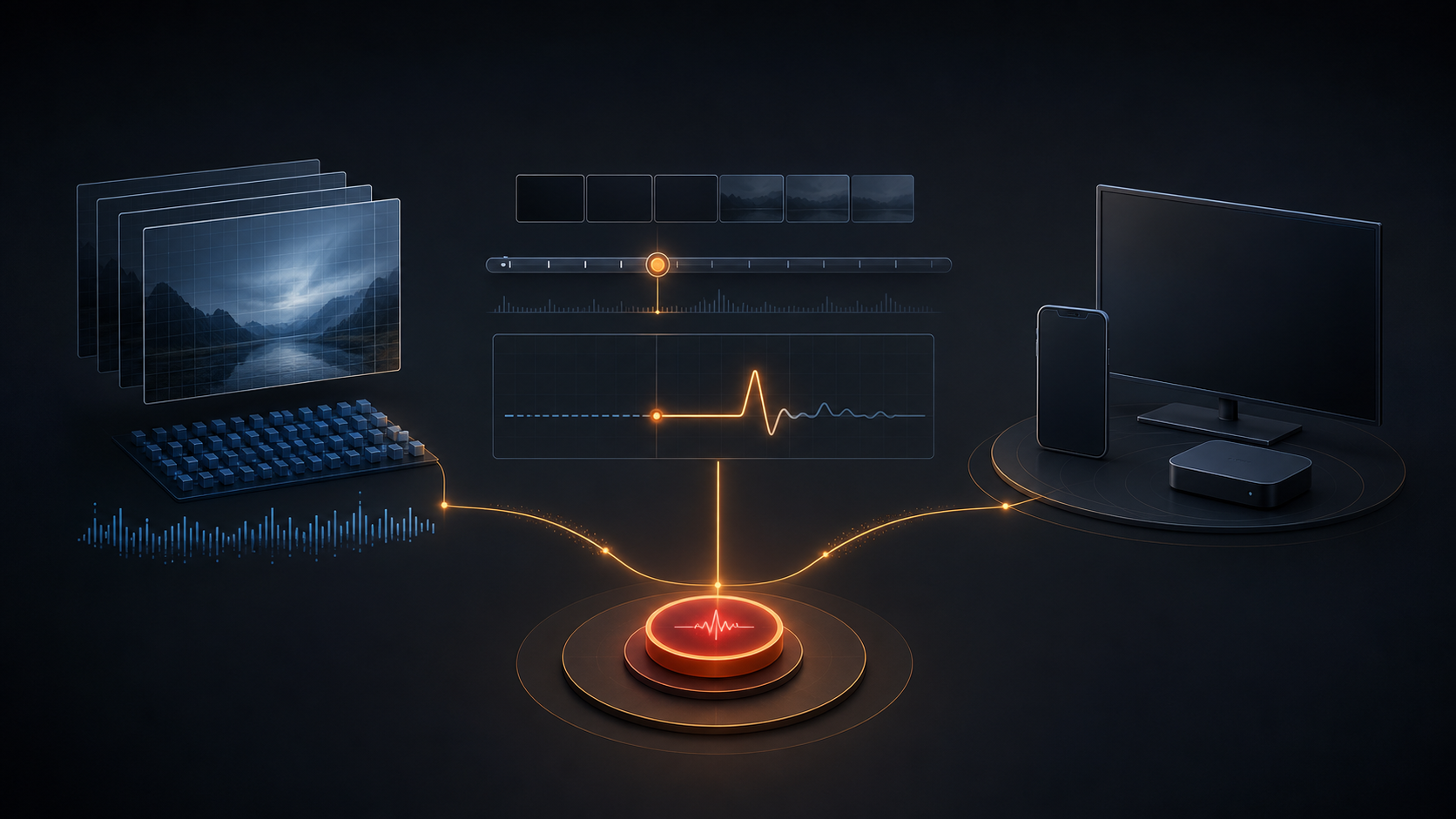
Join media facts with playback facts
Preflight becomes much more powerful when its output uses the same identifiers as production telemetry.
content_id
rendition_id
encoder_profile
codec and resolution
inspection_result
frame_checkpoint_result
device_model and decoder
player_error
startup_time
time_to_first_frame
Now an incident can move from:
Playback failed for some users.
to:
The 1080p HEVC rendition from encoder profile X failed preflight
and correlates with first-frame timeouts on decoder family Y.
That is the difference between collecting logs and building observability.
The real takeaway
OTT platforms already inspect media in many places. The mistake is letting those checks stop at “the job completed” or “the URL returned 200.”
Validate the artifact the way your playback stack will consume it. Test every important rendition, not only the one QA happened to select. Carry the result into device labs and production telemetry.
Media3 Inspector gives Android teams a clean way to contribute to that system. The broader architectural idea applies to every OTT company:
By the time a customer presses play, the platform should already know what it is asking the player to handle.