Walking Is Good, But It Is Not Enough
tl;dr: Why walking is a great start for Indian parents, how it helps the knees, and why strength training is the missing second half.
Language + audio
ಕನ್ನಡ translation available
Health gear i actually use
These are the small, practical buys I keep recommending because they make the habit easier to start and easier to repeat.
Show items
Health gear i actually use
These are the small, practical buys I keep recommending because they make the habit easier to start and easier to repeat.
Yoga mat
A simple base for home workouts
Helps make the floor work, mobility work, and stretching feel easy to start.
Buy yoga mat →
Dumbbells
2.5 kg adjustable dumbbells
A gentle starting point for strength work that still feels useful fast.
Buy 2.5 kg dumbbells →
Resistance band
Bold fit resistance band
Useful for warmups, mobility work, and lighter strength sessions.
Buy resistance band →
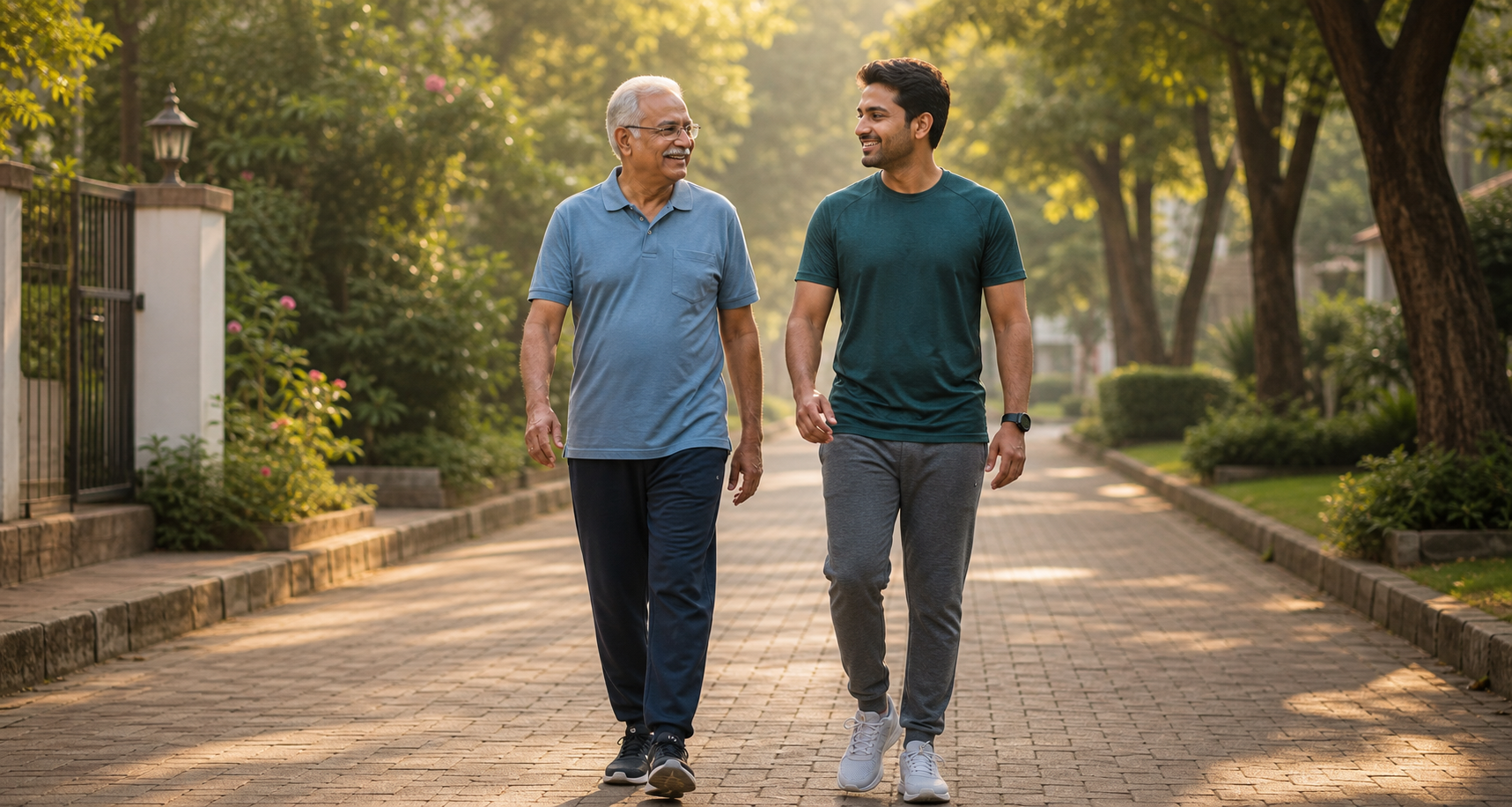
Walking is one of the best habits Indian parents can build.
It is simple. It does not need a gym. It feels familiar. It can happen before breakfast, after chai, or after dinner.
That is exactly why walking works so well as a starting point.
But walking is not the full answer.
If we want better strength, better balance, better stair-climbing, and better support for the knees as the years go by, walking should be the beginning of the routine, not the entire routine.
Daily hook: walk today, then ask one question later: did I also do something that made my legs stronger?
Why walking is good
The World Health Organization says physical activity supports heart health, mental health, sleep, and overall well-being, and it recommends adults also include muscle-strengthening work on at least 2 days a week.
For parents, walking can help with:
- better daily movement
- improved stamina
- a healthier heart and circulation
- less stiffness after sitting
- a routine that is easy to repeat
Walking is especially good because people can usually keep doing it. That matters more than heroic plans that last three days.
Why walking feels good on the knees
For many people, gentle walking feels better than staying still for too long.
That is because movement helps the joint move, and inactivity can make joints feel stiff. NIAMS notes that osteoarthritis often causes pain and stiffness after rest or inactivity.
So a sensible amount of walking can:
- reduce stiffness from sitting too long
- keep the knees moving through a comfortable range
- support the muscles around the joint
- make day-to-day movement feel less rusty
That said, the knee is not a machine that improves only by collecting more steps.
If walking is done too aggressively, too fast, or with poor support, the knee can start complaining.
When walking can bother the knees
Walking is not automatically harmless just because it is common.
It can become a problem when:
- someone jumps from very little movement to long walks too quickly
- the person is carrying extra body weight and starts with too much volume
- shoes are poor or worn out
- the walking surface is hard and unforgiving every day
- the person already has knee pain, arthritis, or a previous injury
- the stride is stiff and rushed instead of smooth
NIAMS lists aging, excess body weight, joint injury, and overuse as factors that can raise the risk of osteoarthritis. That does not mean walking is bad. It means the dose and the context matter.
Common mistakes Indian parents often make
Common patterns I see:
-
Walking is treated as the only exercise
- Great start, but not enough for strength, bone support, or balance.
-
Too much too soon
- One day off the sofa, next day 8,000 or 10,000 steps. The knees may not agree.
-
Walking fast in worn footwear
- Old sandals or flat everyday shoes can make the feet and knees work harder than they should.
-
Thinking household activity equals training
- Cooking, cleaning, market visits, and stairs are useful movement, but they are not the same as progressive exercise.
-
Ignoring the hips, calves, and glutes
- When these muscles are weak, the knees often end up doing extra work.
-
Stopping strength work because of fear
- Many parents worry weights are dangerous. In reality, very light strength training is often the thing that makes walking feel easier.
-
Using pain as the only guide
- Mild effort is fine. Sharp pain, swelling, instability, or repeated pain is not something to push through.
-
No progression
- Same route, same pace, same minutes, every day. Good for habit, not always enough for adaptation.
What to do instead
Try this simple rhythm:
- walk most days for 20 to 30 minutes
- add 2 short strength sessions each week
- do chair squats
- do wall push-ups
- do calf raises
- use light dumbbells if appropriate
That is enough to start.
You do not need a perfect schedule. You need a repeatable one.
The real takeaway
Walking is the base.
Strength training is the support beam.
Together they work much better than either one alone.
If you are helping parents get started, the goal is not to turn them into athletes.
The goal is to help them move through real life with less hesitation.
Start here
If you want the next step after walking, start with these:
- Strong For Them: A Safe Home Workout for Parents Over 50
- Strong With Dumbbells: A Gentle Home Routine for Older Beginners
Walking is good.
Just make sure it is not the only thing keeping your parents strong.
If walking already feels easy, that is a good sign. It means the body is ready for a little more.
The next step is not to do more steps. It is to build stronger legs, hips, and balance so walking becomes easier to keep for years.
Next read:
- Strong For Them: A Safe Home Workout for Parents Over 50
- Strong With Dumbbells: A Gentle Home Routine for Older Beginners